
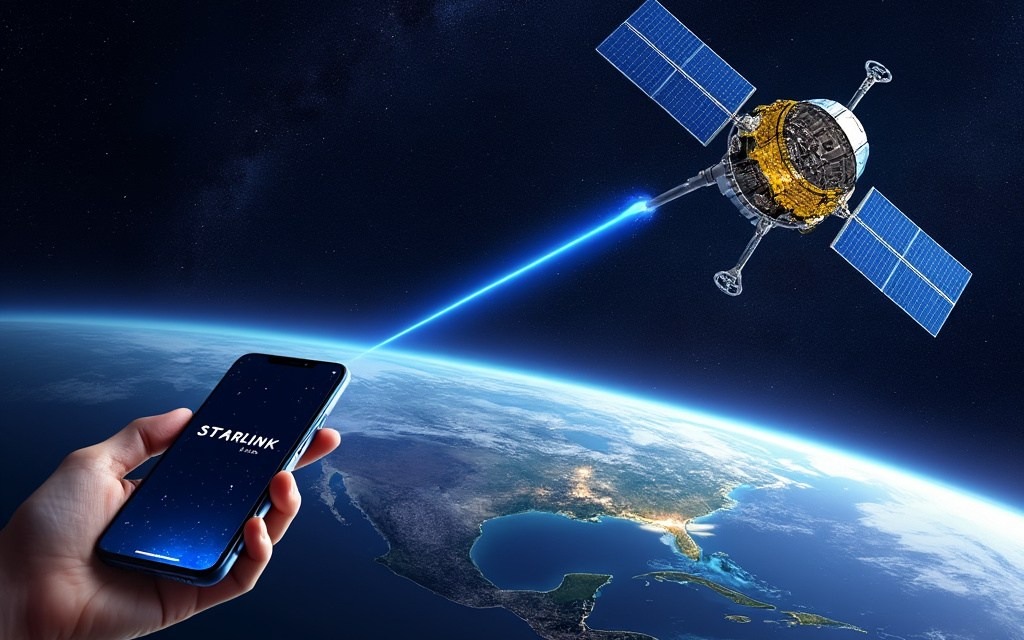
Direct Satellite Connection Technology Now Works with Regular Phones
Imagine taking your phone out in a remote road, in the middle of a mountain, or even on an island without a mobile tower, and sending a message; without an antenna, without a dish, and without buying a satellite phone.
This is no longer just an idea. The "Direct Satellite Connection" technology is now being used on regular phones and is gradually blurring the lines between mobile networks and satellite networks.
Starlink has commercially offered this service in the Philippines, the USA, and New Zealand, and tests and collaborations are underway in countries like Japan, Australia, Canada, Chile, Peru, and Switzerland.
In the Philippines, users with regular phones can access services like messaging, location sharing, emergency alerts, and some lightweight applications in areas where mobile towers do not reach.
Currently, there is no news of watching movies or playing online games via satellite; the capacity of these networks is still limited. But the important change is elsewhere: satellites are no longer just a backup for mobile networks, but are becoming part of the network itself.
Japan is an interesting example of this change. Major operators in this country have launched satellite services for regular phones starting in 2025 and 2026, and millions of users have connected to these services at least once.
This technology is very important for areas like mountains, forests, remote islands, and also during natural disasters; places where building and maintaining mobile towers is costly but the number of users is low.
Meanwhile, China is also building its competitor. The Chinese company Spacesail announced in 2026 that it has made the first direct satellite voice call in the country with regular phones.
However, mobile towers are not going to disappear. In densely populated cities, fiber optics, ground towers, and 5G networks are still essential to handle the massive traffic volume. Satellites are mainly intended to cover areas where building towers is economically or geographically challenging.
Of course, security is also a serious concern. Reports have been published about the vulnerability of some satellite communications and the possibility of intercepting unencrypted communications, prompting operators to strengthen security systems.
In the end, the future will likely be neither completely terrestrial nor completely satellite-based. Cities will still rely on towers and fiber, but the further we move away from the city, the more likely it is that the phone's "antenna" will come from the sky.
Source: Gulf News
Comments
At least 3 characters. Shown after a moderator approves it.
No comments yet
