


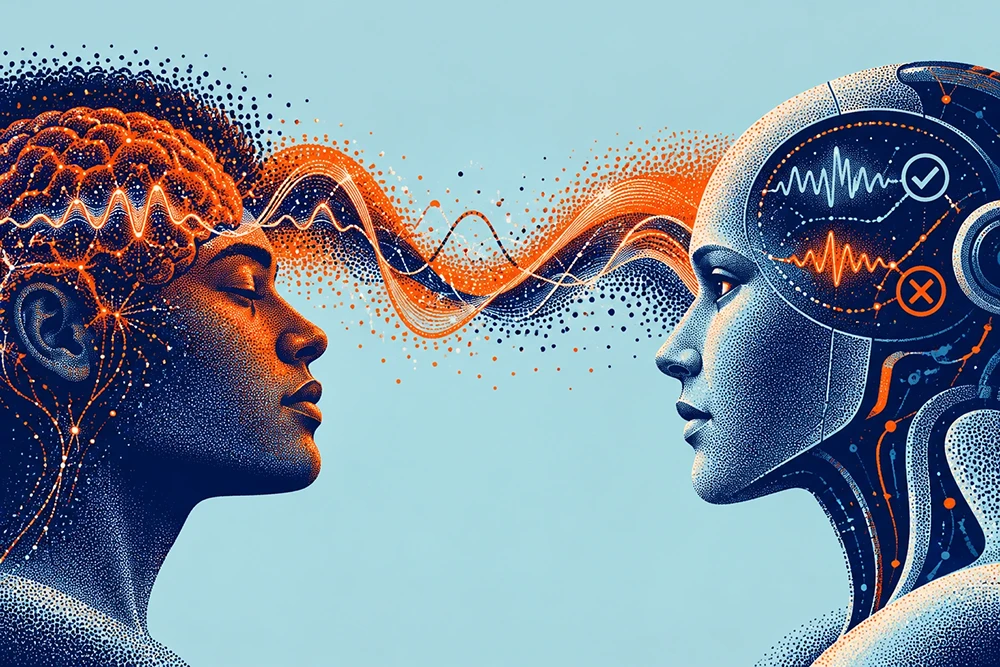
Has Artificial Intelligence Found the Power to Read the Human Mind?
Researchers have developed a new technology that can analyze brain waves to determine whether artificial intelligence has correctly understood the user's true intention or has made a mistake in recognizing their goal and expected method.
This technology could pave the way for a new generation of robots and intelligent systems that can recognize their mistakes and correct their behavior even without receiving verbal explanations.
How does artificial intelligence interpret human intention from brain waves?
Researchers at the Korea Advanced Institute of Science and Technology (KAIST) in collaboration with Microsoft Research Asia have developed a new system in the field of brain-computer interfaces.
This technology uses the electrical activity of the brain to provide a new type of feedback to artificial intelligence systems.
The new method is called Neural Value Alignment (NVA) and utilizes electroencephalography (EEG) to analyze brain activity.
The main goal of this technology is for artificial intelligence to determine without needing the user to explain again whether it has misunderstood their request.
Why is it difficult for artificial intelligence to understand the true intentions of users?
One of the major challenges in human interaction with artificial intelligence is that a behavior or command does not always specify the individual's true goal.
For example, picking up a cup can have different objectives. The person may intend to drink, wash the cup, move it, or hand it to someone else.
On the other hand, a specific goal can also be achieved through various methods.
If a person is thirsty, they might pick up a bottle of water, use a glass, or ask someone else to bring them a drink.
Therefore, observing behavior or receiving a command does not always provide sufficient information for the artificial intelligence system to accurately determine the user's precise goal.
The NVA technology attempts to reduce this ambiguity by analyzing the human brain's reactions.
How does the human brain reveal the mistakes of artificial intelligence?
The human brain continuously makes predictions about future events.
When the outcome of an event differs from what the person expected, it triggers reactions in brain activity.
Researchers in this study focused on two types of neural reactions that can identify the type of mistake made by the artificial intelligence system.
What is the difference between a goal error and a method error?
The first reaction is called Reward Prediction Error.
This error occurs when the final outcome differs from the individual's expected goal.
For example, imagine you ask a household robot to bring you a drink. If you expect water but the robot brings coffee, the final outcome does not match your expectation.
In such a situation, the brain can show a specific reaction to this discrepancy.
The second type is called State Prediction Error.
In this case, the artificial intelligence may have correctly identified the final goal but chosen a different method to achieve it.
For instance, imagine you want water, and the robot has correctly understood your request.
However, instead of picking up the bottle of water next to you, it goes to the kitchen and fills a glass from the tap.
The final outcome is correct, but the method of doing it differs from what you expected.
The new technology can determine from the brain's reaction whether the problem is related to the goal itself or if the artificial intelligence simply chose an inappropriate method to achieve it.
Deep learning comes into play for analyzing brain waves
Researchers found that errors in goals and errors in methods can create different patterns in brain waves during experiments.
Additionally, in some situations, both types of errors may occur simultaneously.
To identify these patterns, researchers used deep learning models to analyze and classify EEG signals.
These models can determine whether the user's brain reaction was due to an error in the final outcome, an error in the method of performing the task, or a combination of both.
One interesting aspect of this system is that the user does not necessarily need to speak, type, or send a new command to provide feedback.
The individual's brain reaction can be directly used as a form of feedback for the artificial intelligence system.
Artificial intelligence can correct its behavior without receiving a new command
Researchers have designed the NVA technology as an algorithm that incorporates decoded neural signals into the artificial intelligence's decision-making process.
In such a system, if the artificial intelligence realizes through the user's brain reaction that it has made a wrong decision, it can change its course of action.
This capability could enable robots and intelligent systems in the future to better align themselves with user expectations without needing to receive continuous corrective commands.
Can artificial intelligence really read the human mind?
Although the term "artificial intelligence mind reading" seems appealing to describe such technologies, the NVA system is still not capable of fully reading human thoughts.
This technology cannot... It extracts all the thoughts of a person or understands exactly what sentence is flowing in their mind. The new system is actually looking for specific neural reactions that occur when observing an unexpected event or a mistake in performance. In simple terms, artificial intelligence is not supposed to understand exactly what you are thinking. Instead, it tries to determine whether what it has done matches your expectations or not. However, this very ability can be an important step in the development of systems that have a more natural and accurate interaction with humans. One of the most significant potential applications of this technology relates to household robots. In the future, a robot may be able to determine from the user's brain reaction that it has not made an appropriate decision while executing a command. In this way, the robot can change its behavior even before the user protests or gives a new command. Industrial environments can also be another area for the use of such technology. Robots that work alongside human labor can use neural signals as an additional channel for receiving feedback. Self-driving cars are also considered another potential application of NVA. In the future, a car's system may be able to take into account not only environmental data and driver behavior but also their neural reaction to certain automated decisions. However, the practical use of such technology in cars still requires extensive research and safety assessments. Medical and rehabilitation robots can also benefit from brainwave-based technologies. This is particularly important for individuals who have limited ability to speak or move. In such cases, brain reactions can become a complementary communication channel between humans and intelligent systems. AI-based educational systems are also another potential application of this technology. Such systems may in the future be able to consider some of the cognitive reactions of students, in addition to their responses, to better adjust the educational process. The mind-reading technology of artificial intelligence is still in its early stages. Despite the promising results of this research, NVA technology is not yet ready for widespread use in everyday products. The experiments conducted so far have mostly been in controlled and simulated conditions. It is still unclear how well a real robot can continuously receive the brain waves of a user and adjust its behavior based on them in an environment like a home. EEG technology also has its specific limitations. The brain signals recorded with EEG can be affected by the individual's movement, environmental noise, and various other factors. For this reason, converting this research achievement into a usable technology in the real world will require further testing and research. This research shows a new path for human communication with intelligent machines. Current systems typically rely on textual, vocal, gestural commands, or other obvious cues to understand the user's opinion. However, if artificial intelligence can receive some brain reactions as feedback in the future, human-machine interaction could become faster and more natural. This capability will be particularly important in robots; as an intelligent system can realize that its decision does not meet human expectations and correct its behavior before receiving a new command. However, the new technology should not yet be considered as truly 'reading minds.' This system is currently more capable of identifying the brain's reaction to a right or wrong event, rather than reading all of a person's hidden thoughts. The results of this research have been published in the scientific journal IEEE Transactions on Cybernetics. Source: Digiato, quoted from New Atlas and the article published in IEEE Transactions on Cybernetics.
Comments
At least 3 characters. Shown after a moderator approves it.
No comments yet
