

Complete Guide to Choosing Health Insurance in the UAE; Which Plan Really Suits You?
Comprehensive Guide to Health Insurance in the UAE in 2026
Many residents of the UAE only ask one question when purchasing health insurance: "What is the cheapest insurance?" However, price is just one of the criteria for choosing insurance. Two policies may have the same annual limit, but one may cover your preferred hospital while the other does not; one may have a reasonable copayment for medications and tests, while the other may leave a large portion of the costs to you.
In simple terms, insurance that is only sufficient for completing or renewing residency is not necessarily the insurance that will financially assist you when you are ill.
In this Gooya guide, we will examine the main rules of health insurance in the UAE, the differences between basic and comprehensive plans, well-known companies, important insurance terms, how to compare healthcare networks, and tips you should know before buying or renewing insurance.
Quick Summary; Which Type of Insurance is Suitable for Whom?
Plan Type | Common Features | Suitable For | Main Potential Limitation |
|---|---|---|---|
Essential Plan | Minimum legal coverage, limited network, higher co-payment | Young and healthy individuals with a limited budget | Fewer hospitals and clinics, limited medication and services |
Enhanced Local Plan | Larger network in the UAE, higher ceiling, lower co-payment | Families, children, and individuals with regular medical visits | May not cover premium hospitals or treatment abroad |
Premium Plan | Premium network, high ceiling, more benefits, and sometimes regional or global coverage | Executives, frequent travelers, families with higher medical needs | Higher premiums and more stringent medical assessment conditions |
International Plan | Elective or emergency treatment in several countries or worldwide | Those who travel regularly or spend part of the year outside the UAE | High cost and potential exclusions for the USA and Canada |
This table is a general guide. The plan name alone is not sufficient, and the final decision should be based on the benefits table, the healthcare network list, exclusions, and policy conditions.
Is health insurance mandatory in the UAE?
Yes, but the regulations and the type of basic plan are not the same in every emirate.
Dubai
In Dubai, all residents must have valid health insurance. The employer is responsible for providing insurance for the employee. If the employer does not cover the employee's spouse and children, the responsibility for providing insurance for dependents falls on their sponsor. The same principle applies to domestic service workers. Official guide of ISAHD and Dubai Health Authority
Abu Dhabi
In Abu Dhabi, health insurance is also mandatory for non-Emirati nationals and their resident families, and the plans must comply with the regulations of the Department of Health – Abu Dhabi. The employer's and sponsor's responsibilities in Abu Dhabi differ from those in Dubai; therefore, the conditions of one emirate should not be generalized to another. Abu Dhabi Health Insurance Law
Sharjah, Ajman, Umm Al-Quwain, Ras Al Khaimah, and Fujairah
As of January 1, 2025, obtaining health insurance for private sector employees and domestic service workers in these five emirates has also become one of the conditions for issuing or renewing residency. The basic package of this plan is offered at the announced price of 320 dirhams per year. This package is designed for individuals aged 1 to 64, and individuals over this age must provide a medical declaration form and related documents. Official guide of the Ministry of Human Resources and Emiratisation
In this plan, the patient's share for hospitalization is 20 percent; with a cap of 500 dirhams for each visit and a maximum of 1,000 dirhams per year. For outpatient services, the patient's share is 25 percent and a maximum of 100 dirhams for each visit. For follow-up visits for the same illness within seven days, no reimbursement is received. The patient's share for medication is 30 percent and the announced annual cap is 1,500 dirhams.
Important note: The 320 dirham package pertains to the federal basic plan for the mentioned emirates and should not be confused with the Essential Benefits Plan in Dubai.
What coverage does the Dubai basic plan provide?
The basic plan approved by the Dubai Health Authority or Essential Benefits Plan (EBP) is the minimum standard of health insurance in Dubai. According to current information from the Dubai Health Authority:
Its annual aggregate cap is 150,000 dirhams.
Basic medical services are primarily provided within the emirate of Dubai.
Emergency treatments, including ambulance services, are covered throughout the emirates.
Using a limited healthcare network in this type of plan is permitted, provided that there is acceptable geographical access for the insured individual.
Hospitalization, outpatient services, part of maternity services, vaccinations, and preventive services are covered according to the benefits table.
As of the time of preparing this content, the prices listed for eligible basic plans are approximately between 525 and 750 dirhams. These figures are not guaranteed prices for all individuals, and the final amount may vary based on age, individual status, taxes, administrative costs, and current conditions. Official list of companies and benefits of the Dubai basic plan
The basic plan can be suitable for fulfilling legal requirements and covering major risks, but before purchasing, you should ensure that the clinic near your residence, general practitioner, laboratory, pharmacy, and acceptable hospital are within the same network level.

What are the differences between enhanced and comprehensive plans?
Enhanced plans typically offer one or more of the following benefits compared to basic insurance:
Higher annual limit; for example, 250,000, 500,000, one million dirhams or more
Larger network of hospitals, clinics, laboratories, and pharmacies
Better access to premium private hospitals
Lower copayment for visits, tests, imaging, medications, or hospitalization
Broader coverage for chronic and pre-existing conditions
Higher maternity benefits
Coverage for physiotherapy, mental health, dental, or vision services
Possibility of treatment in other countries in the region or worldwide
Private room during hospitalization
Partial reimbursement for out-of-network services
For example, the company Sukoon has introduced six levels in the HealthPlus product named Safe, Home Lite, Home, Max, Pro, and Prime, with annual limits ranging from 150,000 to 5 million dirhams. The network, geographical range, copayment, and maternity benefits also differ among these levels. This example shows that even plans from one company can vary significantly from each other. Official HealthPlus Table
The company Daman also offers comprehensive plans with local coverage and global coverage options for individuals and families, in addition to the basic Abu Dhabi plan, and announces access to over three thousand healthcare providers in the UAE on its website. Daman Individual and Family Plans
These examples do not imply superiority of one company over another. The best plan is the one that aligns with your residence, preferred hospitals, medical history, budget, and actual needs of your family.
What are the most famous health insurance companies in the UAE?

Many insurance companies operate in the UAE market. The following names are seen in the current list of eligible companies offering the basic Dubai plan:
Qatar Insurance Company or QIC
Cigna Insurance Middle East
Union Insurance
National General Insurance or NGI
Al Buhaira National Insurance
Sukoon
Dubai National Insurance or DNI
Salama
ADNIC
Dubai Insurance
MetLife
Noor Takaful
Al Sagr National Insurance
Orient Insurance
Daman is also one of the most recognized names, especially in the Abu Dhabi market, and GIG Gulf also operates in the UAE health insurance market.
The presence of a company on the official list means that it is qualified to offer the relevant product; however, this list does not rank quality or declare 'best insurance'. Each company has multiple plans and several network levels, and a specific plan from one company may be suitable for you, while another plan from the same company may not meet your needs.

What is the difference between an insurance company, TPA, and healthcare network?
This is one of the most important sections that many insurance buyers do not pay attention to.
Insurance Company or Insurer
This is a company that issues insurance policies and accepts the financial risk of the contract. The name must be specified in the insurance policy and benefits table.
Healthcare Services Manager or TPA
Some insurance companies delegate the management of the healthcare network, service approvals, and claims handling to a third-party company. Names like NextCare, NAS, MedNet, and Neuron are commonly seen in this role. These companies are not necessarily the issuers of the insurance policy; rather, they may manage the network of healthcare centers, medical approvals, and claims on behalf of the insurer. NextCare, NAS, MedNet, Neuron
Network Level
Having a TPA logo on your card does not mean you have access to all hospitals in that network. Each TPA has several network levels. For example, a hospital may be in the premium network, but not included in the basic plan of the same TPA.
Therefore, the correct question is not 'Is this insurance from NextCare or NAS?' The correct question is:
What is the exact name of the network and its level, and which hospital branches are included?
Why is the healthcare network more important than the company name?
Imagine you have an insurance policy with an annual limit of one million dirhams, but it does not cover the hospital near your home. In contrast, an insurance policy with a lower limit may have all the doctors and centers you use in its direct network. In everyday life, the second option may be more practical.
Before purchasing, at a minimum, check the following items in the network list:
Suitable hospital for admission
Clinic or general practitioner near home or workplace
Required specialists; such as cardiology, gynecology, pediatrics, orthopedics, or gastroenterology
Laboratory and imaging center
Available pharmacies
Separate coverage for outpatient and inpatient
Exact branch of the healthcare center, not just the name of the group
A branch of a hospital may be in the network while another branch of the same brand may be out of network. Additionally, networks change throughout the year; therefore, it is better to obtain an updated and dated list before making a payment.
A high annual limit does not always mean better insurance
The annual limit or Annual Limit is the maximum amount that the insurance pays in one insurance year, according to the terms of the contract. However, within this limit, there may be smaller restrictions; for example:
Medications up to a specified limit
Physiotherapy only a limited number of sessions
Natural childbirth and cesarean with separate limits
Treatment of pre-existing conditions up to an amount less than the main limit
Mental health with a limited ceiling
Dental and vision with separate annual limits
Organ transplants or specific treatments with independent limits
Therefore, the phrase 'coverage of one million dirhams' does not mean that all medical services are paid up to one million dirhams without limits. The benefits table and sub-limits are more important than the large number on the brochure.
Important terms to know before purchasing
Premium
This is the amount you pay to purchase the insurance policy. A lower premium is usually associated with a more limited network, higher out-of-pocket costs, or fewer benefits.
Deductible
This is a fixed amount that you pay upfront for certain services before the insurance starts to pay.
Co-pay
This is a fixed amount you pay for each visit or service; for example, 50 dirhams for each visit.
Coinsurance
This is a percentage of the cost that you are responsible for; for example, 20 percent of the cost of a test or medication. In everyday conversations in the UAE, sometimes the term Co-pay is used for both types of out-of-pocket costs; therefore, read the number and calculation method carefully.
Direct Billing
The treatment center receives the costs directly from the insurance, and you only pay your share.
Reimbursement
You initially pay the full cost yourself and then submit the documents for reimbursement to the insurance. The reimbursement percentage, calculation basis, and document submission deadline should be checked.
Pre-authorization
Insurance pre-approval is required for certain services such as planned hospitalization, surgery, MRI, expensive tests, or specific treatments. Performing a service without approval may result in denial or reduction of payment.
Pre-existing and chronic conditions; the most important part of the insurance form
If you have diabetes, high blood pressure, heart disease, asthma, thyroid problems, a history of surgery, spinal diseases, psychiatric issues, or any other known illness, declare it in the medical statement.
Concealing a pre-existing condition may lead to denial of claims or even cancellation of coverage in the future. On the other hand, declaring a condition does not necessarily mean denial of insurance; the company may accept the condition, set additional premiums, impose limits, or apply waiting periods.
Before purchasing, get written answers to these questions:
Is the pre-existing condition accepted?
What is the coverage limit?
Is there a waiting period?
Are related medications and tests covered?
Is my current doctor or treatment center in the network?
In some basic plans, specific conditions are set for chronic and pre-existing diseases. For example, the new basic plan from the Ministry of Human Resources for eligible employees has not declared a waiting period for chronic diseases; however, the conditions of all insurance policies are not the same.
Maternity Insurance; just seeing the word Maternity is not enough
Maternity coverage is usually one of the most expensive parts of health insurance. Before purchasing, the following should be clarified:
Waiting period for maternity coverage
Limit for prenatal care
Number of visits and ultrasounds
Limit for normal delivery
Limit for necessary cesarean
Patient's payment share
Hospitals that can be used
Coverage for pregnancy complications
Conditions for newborn coverage in the first days
Deadline for adding the newborn to the policy
If a person is pregnant at the time of purchasing insurance, the conditions and price may vary significantly. Never rely solely on the phrase 'has maternity'; check the financial limit and waiting period in the benefits table.
Medications, tests, and imaging; costs that are felt before reaching the insurance limit
Most people do not get hospitalized every year, but they may visit the doctor several times, get tests, or obtain medications. Therefore, for daily use, the following are very important:
Percentage of medication payment
Annual limit for medications
List of approved medications or Formulary
Need for a prescription or prior approval
Patient's payment share for tests and imaging
Limitations on MRI, CT Scan, or specialized tests
Number of physiotherapy sessions
Sometimes a cheap plan has a high payment share for medications and tests, and at the end of the year, its actual cost exceeds that of a slightly more expensive plan.
Dental, vision, and routine check-ups are usually not automatic
Many basic plans do not cover dental and vision or only accept emergency cases. In more comprehensive plans, these services may also be offered as optional with limited coverage.
Preventive services and annual check-ups are also not necessarily included in all plans. If these are important to you, you should check the names of the tests, frequency, limits, and usable centers in the benefits table.

What type of insurance is more logical for each group?
Young and Healthy Individual
If you have minimal medical visits and your main goal is legal coverage and protection against hospitalization and accidents, a basic plan with an acceptable network close to home may be sufficient. However, make sure to check the hospitalization and emergency coverage.
Family with a Child
Access to a pediatric specialist, nearby hospital, vaccinations, tests, medications, and outpatient visits are very important. For families, reducing out-of-pocket expenses and easy access are usually more important than the lowest price.
Individual with a Chronic Illness
Written acceptance of the illness, medication limits, periodic tests, relevant specialists, and the absence of inappropriate restrictions should be prioritized. Do not just look at the overall annual limit.
Couple Planning to Have Children
Look for a plan that clearly outlines the waiting period, delivery limits, pregnancy care, and newborn coverage. It’s better to obtain this insurance before pregnancy.
Elderly Parent
At older ages, price is not the only suitable criterion. Coverage for pre-existing conditions, chronic medications, heart issues, imaging, nearby hospitals, ambulance services, and an easy service approval process are more important.
Frequent Traveler
You should understand the difference between "emergency coverage outside the UAE" and "elective treatment abroad." Some plans only accept emergencies outside the UAE, while others also cover planned global treatment. The USA and Canada are often calculated separately or excluded in many plans.
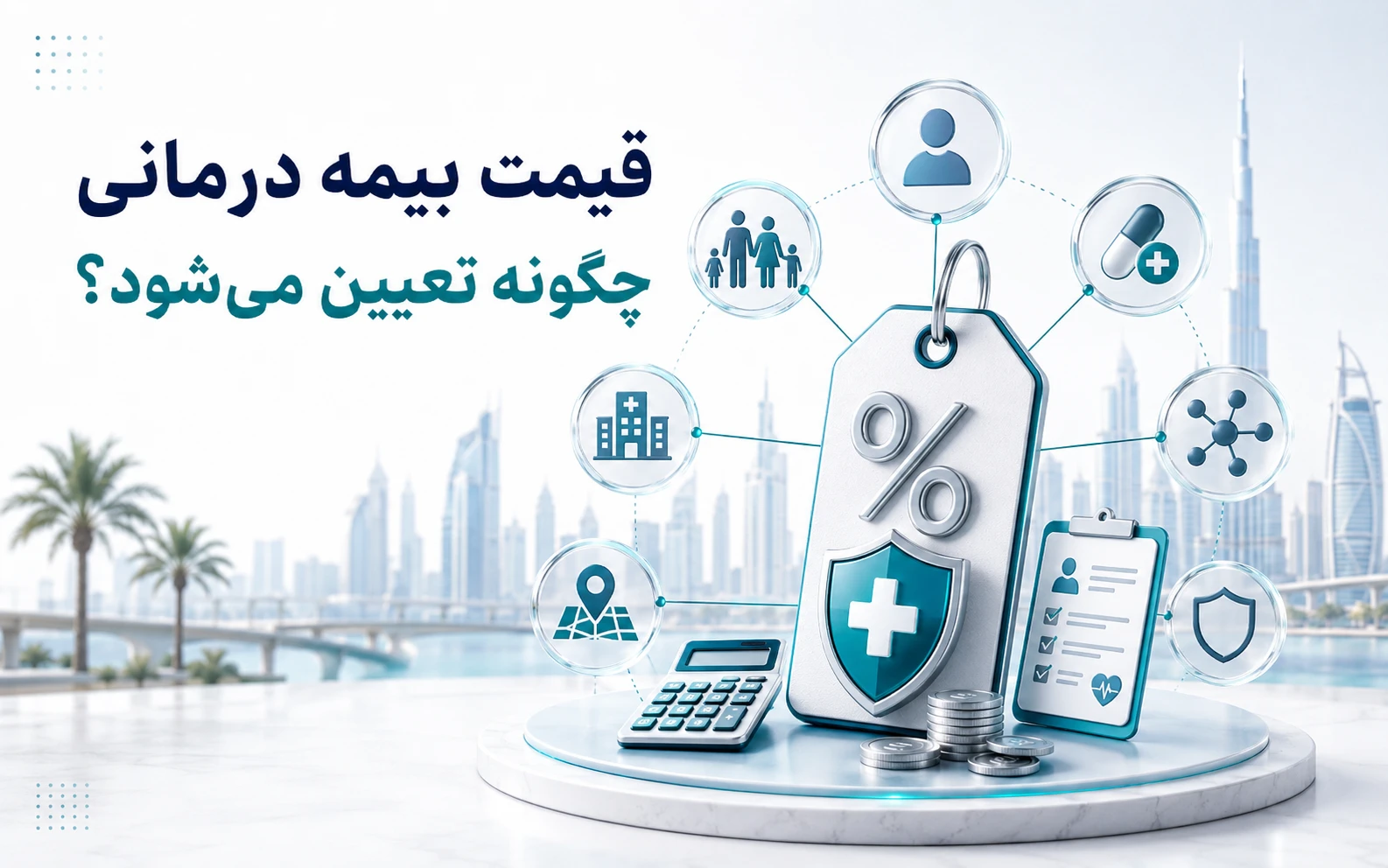
How is health insurance pricing determined?
The final price can be influenced by the following factors:
Age
Gender
Emirate of visa issuance
Individual, family, or group insurance
Medical history and pre-existing conditions
Pregnancy or need for maternity coverage
Level of medical network
Annual limit
Geographical coverage area
Amount of deductible and co-payment
Dental, vision, and other additional benefits
Reimbursement ratio for out-of-network services
For this reason, stating a fixed price for "comprehensive insurance" without obtaining individual details and a benefits schedule is not reliable.
Ten-Point Checklist Before Purchasing Insurance
Before making a payment, ask these ten questions and get written answers whenever possible:
What is the exact name of the insurance company?
What is the name of the TPA and the exact level of the network?
Which hospitals are in-network for hospitalization?
What is the nearest clinic, laboratory, and pharmacy?
What are the annual limits and important sub-limits?
What is the co-payment for visits, tests, medications, and hospitalization?
How are pre-existing and chronic conditions covered?
What are the conditions for maternity, newborn, dental, vision, and physiotherapy?
What percentage is reimbursed for out-of-network services?
What is the final amount including tax and all issuance fees?
Also, keep a copy of these documents:
Table of Benefits
Insurance Policy Terms and Exceptions
Network List with Date
Registered Medical Declaration
Payment Receipt
Email or Written Confirmation of Pre-existing Conditions
What to do if the insurance denies treatment costs?
The initial denial does not always mean the end of the case. First, identify the exact reason for the denial. Common reasons can include the center being out of network, lack of prior approval, incomplete documentation, the existence of exceptions, or a diagnosis of "medical necessity not being met".
Suggested Steps:
Obtain the code and reason for denial from the treatment center.
Contact the TPA or insurance company using the number on the card.
Get a tracking number and complete the medical documents, prescription, doctor's report, and detailed invoice.
File a review request or formal complaint first with the insurance company.
If the issue is not resolved, you can use the free complaint system of the Dubai Health Authority in Dubai. DHA Complaints System
For disputes with a licensed insurance company in the UAE, after attempting to resolve the issue directly with the company, you can also file a complaint with Sanadak. Sanadak Official System
Keep all emails, tracking numbers, doctor's reports, prescriptions, invoices, and written responses to claim denials.
Common Mistakes When Buying Insurance
Choosing insurance solely based on the lowest price
Focusing on the company name while ignoring the network level
Trusting the total number of centers without checking specific hospitals
Not disclosing pre-existing conditions
Not checking the limits for medications, maternity, and specific treatments
Assuming that all out-of-network services will be reimbursed
Purchasing maternity coverage after pregnancy begins without checking conditions
Not reviewing the new network when renewing
Assuming that an employer's insurance automatically covers the spouse and children
Paying without receiving a written table of benefits and final price
Frequently Asked Questions
Is basic insurance sufficient for everyone?
No. It may be suitable for a healthy individual with limited medical needs, but for families, seniors, individuals with chronic illnesses, or those who prefer a specific hospital, upgraded options usually need to be compared.
Does a one million dirham cap mean all costs are covered?
No. Co-payments, exceptions, sub-limits, network, and medical necessity still apply.
Can one go to any hospital?
No. For Direct Billing, the hospital and its branch must be within your specific network. Out-of-network visits may only be accepted in emergencies or on a reimbursement basis under specific conditions.
Can a pre-existing condition be undisclosed?
This is very risky. The insurer can deny related claims due to non-disclosure of medical information. Accurately disclose the condition and obtain written confirmation of acceptance.
Does employer insurance cover the spouse and children?
Not necessarily. In Dubai, the employer is required to insure the employee, but if the family is not covered under the company plan, the sponsor must provide insurance for dependents. In Abu Dhabi and other emirates, regulations and employment contracts must be reviewed separately.
Are dental and optical services covered by health insurance?
In many basic plans, no. In more comprehensive plans, they may be offered with a limited ceiling or as an additional option.
Summary; Good insurance is not necessarily the most expensive insurance
To choose the right health insurance, first identify your actual needs: Which hospital do you want? How many times a year do you visit a doctor? Do you have a chronic medication, a pre-existing condition, a child, a pregnancy plan, or frequent travels?
After that, put three things together:
Benefits table
Detailed list of the treatment network
Your actual costs including premiums and co-payments
If these three align with your needs, a mid-range plan may be a better choice than an expensive but disproportionate plan. The purpose of insurance is not just to complete the residency file; the goal is to know where to go when you are sick, how much you will pay, and what services are actually covered.
Health Insurance Selection Consultation
This guide is prepared with the support of JBS .
To compare plans, review the network of hospitals and clinics, and get introduced to an authorized insurer or broker, you can contact JBS.
WhatsApp and contact: 0506300189
This content is for general guidance only. The final criteria for coverage are the insurance policy text, benefits table, network list, and written confirmation from the insurance company.
Prepared and organized by: Gooya Editorial Team
