


Opening a Bank Account in Dubai in 2026
Categories:

Everything About Opening a Bank Account in Dubai
Short answer: A resident of the UAE typically applies for an account with a passport, residence visa, Emirates ID, proof of address, and proof of employment or income. The bank may request additional documents regarding the source of funds, employment activity, and expected transactions based on the product and risk assessment. Having complete documentation does not guarantee approval, especially for cases requiring further compliance checks.
Opening a bank account is one of the first essential tasks after settling in the UAE, but there is no single answer to "the best bank" or "approval time." Minimum salary, minimum balance, fees, checkbook availability, and acceptance policies for each product vary and may change with customer risk assessment.
For Iranian applicants, the best way is not shortcuts; the file must be clear and coherent. Job information, income, address, tax residency, and source of funds must align with actual documents and transactions.
First, Choose the Right Type of Account
Account Type | Suitable For | Main Point |
|---|---|---|
Salary Account | Employee with regular salary deposits | May have minimum salary or salary transfer conditions |
Current Account | Daily payments and in some products checkbook | Usually for residents and with income or balance conditions |
Savings Account | Keeping money and receiving potential interest | May not have a checkbook and may have withdrawal limits |
Non-Resident Account | Individual without residency eligible | Often savings, with limited services and more scrutiny |
Business Account | Company or licensed activity | Company documents, beneficial owner, and economic activity are required; not a substitute for a personal account |
If your goal is to receive salary and rent a house, ask your employer if there is a specific bank for salaries. If your goal is just to keep savings, choose an account with balance and fee conditions that suit you. Using a personal account for business purposes may lead to compliance questions or account restrictions.

Basic Documents for UAE Residents
The official guide from the UAE government and bank pages usually mention these documents:
Valid passport.
Valid UAE residence visa.
Valid Emirates ID or in some cases, the application receipt.
Proof of address such as Ejari, utility bill, or a bank-accepted document.
Salary certificate, employment letter, contract, or pay slip.
Recent bank account statements for the last few months, if requested by the bank.
Name, date of birth, address, and employment status must be consistent across all forms. If you have recently entered the UAE and do not yet have a local bill or bank history, ask the branch which alternative they accept.
Additional Documents That May Be Requested
The Central Bank's consumer protection standards emphasize a risk-based approach and customer identification. Depending on the case, the bank may request the following:
Statements from the previous account for three to six months.
Proof of source of funds; such as salary slips, asset sale contracts, company profits, or inheritance.
Explanation of the source of wealth for large balances or transfers.
Country of tax residence and tax identification number, if applicable.
Explanation about the countries of origin and destination of transfers and expected volumes.
For self-employed individuals or business owners: business license, articles of association, list of partners, invoices, and employment contracts.
Submit documents only through the official bank channels. Do not send sensitive information to anonymous intermediaries or personal numbers.
Suggested Steps for Opening an Account
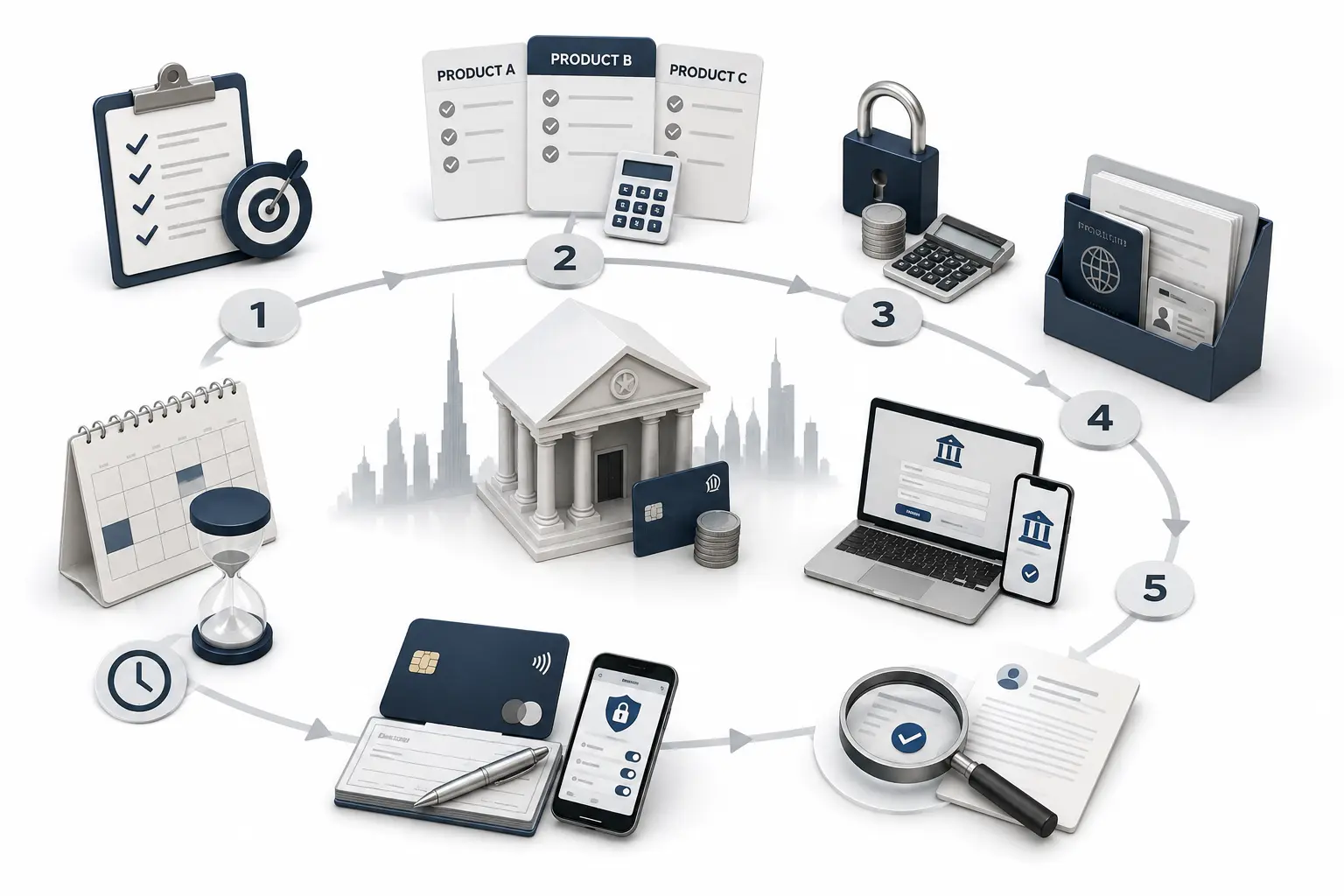
Define your needs: salary, checkbook, savings, international transfers, or daily use.
Compare the Key Facts Statement and fee schedule of at least three products.
Note the minimum salary or average balance requirements and the low balance fee.
Prepare the basic documents and source of funds before applying.
Apply through the official app or branch and obtain a tracking number.
If additional documents are requested, provide precise and consistent responses.
After approval, set up transfer limits, beneficiaries, cards, checkbooks, and app security.
The review time can vary from a few days to a few weeks. A long review does not necessarily mean rejection, and online applications are not always faster than branch applications.
Special Tips for Iranian Applicants
Banks do not have a uniform and general policy for all Iranian applicants. Decisions are not explained solely based on nationality; the bank assesses product, residency status, occupation, source of funds, geographical connections, and compliance risk together. The case may be sent for Enhanced Due Diligence and additional documents may be requested.
To reduce back and forth, have this package ready:
Passport, visa, and Emirates ID.
Ejari or acceptable proof of address.
Employment letter, pay slip, and employment contract.
Bank statements for three to six months and a clear explanation of the initial balance.
Documents for asset sales, company income, or any major source of funds.
For business owners: license, company documents, invoices, and contracts that demonstrate actual activity.
A realistic list of transaction countries, currencies, and monthly volume.
Conflicting information, multiple simultaneous requests with different responses, or attempts to conceal the source of funds reduce the chance of a smooth review and can have serious consequences. If a specific transfer is uncertain due to sanctions or regulations, seek guidance from the bank's compliance unit or a specialized legal advisor before proceeding. No method of circumventing banking controls, using someone else's account, or misrepresenting transactions is a safe or legal solution.
What is the difference with a non-resident account?
Some banks offer accounts for non-residents, but typically the range of products is more limited, with more document scrutiny and a higher minimum balance requirement. For example, a bank may request a passport and entry document, proof of address in the country of residence, a letter from the current bank, and account statements. A non-resident account does not necessarily come with a checkbook, credit, or all the features of a resident current account.
If your residency is about to be issued, ask the bank if it is better to wait until you receive your Emirates ID. Opening an inappropriate product and trying to convert it immediately is not always the fastest route.
How to compare minimum salary and minimum balance?

There is no general number for all banks. Some accounts have a salary transfer requirement, some require a minimum monthly balance, and some a combination of both. For example, the documents for some banking products mention figures of 3,000 or 5,000 dirhams for balance or salary, but these numbers do not represent a rule for all banks.
Find these items in the Key Facts Statement:
Minimum salary or minimum average balance.
Monthly fee if balance falls below minimum.
Cost of additional cards, checkbooks, domestic and international transfers.
Currency conversion rates and intermediary bank fees.
Interest rates, calculation methods, and withdrawal limits for savings accounts.
Conditions for closing the account in the first months.
The "no monthly fee" product may be more expensive in currency conversion or transfers. Compare costs based on your actual usage.
After opening the account, do these five things
Enable transaction notifications and two-step login.
Set the daily transfer limit according to your actual needs.
Obtain the bank's contact number only from the app, card, or official website.
Never give one-time passwords, PINs, or login information to the caller.
Keep documents proving the source of funds for large transfers to respond quickly if questioned.
Common mistakes

Account selection based solely on the opening gift or short-term promotion.
Not seeing the drop in balance fees and currency conversion rates.
Providing different address, job, or income in various forms.
Depositing a large amount without preparing proof of the source of funds.
Using a personal account for regular business transactions.
Trusting someone who promises "definitive approval" or bypassing bank verification.
Frequently Asked Questions
Can Iranians open a bank account in Dubai?
There is a possibility to apply, but approval depends on the bank, product, and a complete risk assessment and compliance. Additional documentation regarding the source of funds and transactions may be requested, and no intermediary can guarantee approval.
Can an account be opened without an Emirates ID?
For most resident full accounts, the Emirates ID is the primary document. Some banks may start the process with a request receipt or have non-resident products, but services and conditions will vary.
Is it mandatory to deposit a salary for a current account?
Not for all products, but there may be a salary condition or average balance requirement. The product page and Key Facts Statement of the same bank are the criteria.
What should I do if my application is rejected?
First, ask if any document or explanation is incomplete, although the bank may not disclose the details of the risk decision. Check your information and only apply with a real and coherent file for another suitable product. Do not alter responses to appear "aligned" with the bank's expectations.
What documentation is required for transferring money from outside the UAE?
It depends on the amount, country, counterpart, and source of funds. Account statements, sales contracts, pay slips, company documents, or explanations of the relationship with the sender are common documents. Coordinate with the receiving bank before a large transfer.
Official and Banking Resources
Legal and Financial Note: This content is a general guide and does not constitute financial, legal advice, or a guarantee of bank acceptance. The terms of each product and compliance policies may change without prior notice.