
Cancelled Projects in Dubai; Refund Law, DLD List, and Court Ruling
Cancelled Projects in Dubai; Buyers' Rights, DLD List, and Refunds
Short answer in one sentence
If an off-plan project in Dubai has been officially cancelled by a final and reasoned decision from RERA, the legal principle is that the buyer should recover all amounts paid; however, if the escrow account balance and other recoverable assets of the project are insufficient to pay all buyers, only a portion of each buyer's claim, usually in proportion to the verified claims, may be paid during the liquidation phase.
Therefore, these two concepts should not be confused:
The amount of claim or legal right of the buyer: it may be 100% of the amounts paid.
The actual recovery amount in a stage of liquidation: it may be 20%, 40%, 70%, or any other ratio; as it depends on the divisible balance of that project.
The fact that the court or DLD is currently distributing 40% of the verified claim does not necessarily mean that the law recognizes only 40% as the buyer's right.
Why are the cases of purchases from 2006 to 2008 still open?
During the boom years of the Dubai market, especially from 2005 to mid-2008, a large number of units were pre-sold. Some projects were only on paper, some started initial works, and some were halted after the 2008 financial crisis. During that period, issues such as the following were more common:
Direct receipt of money by the developer, before the widespread adoption of project escrow accounts;
Non-registration or incomplete registration of contracts in Oqood or the initial property registration office;
Selling a unit in the secondary market and paying a "premium" to the previous buyer, not to the developer;
Transfer of land from a sub-developer or disputes with the master developer;
Spending part of the funds on land, design, marketing, or initial operations;
Bankruptcy, dissolution, or lack of sufficient assets with the developer company;
Multiplicity of buyers, contracts, transfers, receipts, and different rulings;
Prolonged sale of land or other assets and determining the final list of stakeholders.
For this reason, even after buyers' rights were clarified in law, converting this right into cash in some projects has taken years.

First, the project's status must be accurately assessed
In everyday conversations, any project that has not been built is referred to as "cancelled"; however, legally this interpretation is not always correct.
Status | Legal and Practical Meaning |
|---|---|
Delayed or Stopped Project | Construction is delayed or stopped, but a final cancellation decision has not yet been issued. |
Under Cancellation | RERA is processing the review, technical report, notice, or objection from the developer; a final decision does not necessarily exist yet. |
Officially Cancelled | RERA has cancelled the project with a final and reasoned decision, and the refund or settlement process begins. |
Incomplete and Referred for Revival | The project may be assigned to another developer or restructured for completion. |
Cancellation of a Buyer’s Contract | The developer has terminated a buyer's contract, for example, due to non-payment of installments; this is fundamentally different from the cancellation of the entire project. |
The official Project Status Enquiry service on the DLD website and the Dubai REST app allows you to check the official status using the project name, project number, or land number. Simply closing the workshop or the disappearance of the developer does not replace the official decision of RERA.
Official Project Status Inquiry Service at DLD
History of Regulations; From Escrow Accounts to Special Courts
1. Law No. 8 of 2007; Project Escrow Account
Law No. 8 of 2007 in Dubai required developers of off-plan projects to have a separate escrow account for each project. Buyers' funds must be deposited into the account of that project and cannot generally be seized for the developer's other debts.
Article 15 of this law states that if an emergency situation prevents the project from being completed, the account trustee must coordinate with DLD to protect the rights of depositors; either facilitate the completion of the project or refund the buyers' funds.
Official Text of Law No. 8 of 2007
DLD has clarified in its official inquiries that the escrow account law was not only for new projects; projects announced before the law was enacted were also generally included, and developers had six months to comply. However, in practice, some of the funds for older projects may have been received or spent before the escrow account was established.
2. Law No. 13 of 2008; Initial Registration of Off-Plan Transactions
This law established the "Initial Real Estate Registration Office" for registering off-plan sales transactions. Contracts and off-plan transfers must be registered in this office. Transactions prior to the law's commencement also had to be submitted for registration.
The 2010 executive regulation also stipulated that even if the developer submits the registration request later, DLD must register the transaction and fine the developer. Therefore, the age of the contract alone does not mean the loss of rights; however, the lack of Oqood registration or initial office registration may make it more difficult to prove contractual ownership and the amount owed.
Official Text of Law No. 13 of 2008
Executive Regulation No. 6 of 2010
3. 2010 Regulation; When Can RERA Cancel a Project?
Article 23 of Regulation No. 6 of 2010 allows RERA to cancel a project based on a reasoned technical report in cases including these circumstances:
The developer has not commenced construction without a valid reason;
Serious violations related to the escrow account or fraudulent sales have occurred;
It becomes evident that there is no genuine intention to execute the project;
The land has been reclaimed from the developer due to a violation;
The land has been completely affected by redesign or new planning;
The project has not been executed due to the heavy negligence of the developer;
The developer has notified RERA with valid reasons that they will not execute the project;
The developer has gone bankrupt;
Or there are other reasons that RERA deems to exist.
The developer has a short period to appeal the cancellation decision according to this regulation. After the cancellation is finalized, the financial audit of the project and the refund process will begin.
4. Decree No. 21 of 2013; Establishment of a Special Judicial Authority
What is sometimes referred to as the “2013 Sheikh Mohammed Law” is more precisely Decree No. 21 of 2013, issued on July 23, 2013, by Sheikh Mohammed bin Rashid Al Maktoum.
This decree established the “Court or Special Authority for the Liquidation of Canceled Real Estate Projects and Determination of Related Rights.” Its main duties included:
Handling disputes between developers and buyers related to officially canceled projects;
Liquidation of the project after RERA's final decision;
Reviewing the escrow account, buyers' payments, and project costs through an auditor;
Issuing orders to the escrow bank or developer to return funds;
Selling and collecting assets and determining the distribution method after deducting liquidation costs;
Addressing appeals and related execution issues.
This decree also limited the ordinary jurisdiction of other courts in these cases. Cases and even the execution of previous rulings related to liquidation had to be transferred to the special authority. The rulings of this authority are final, not subject to ordinary appeal, and enforceable by the execution department of Dubai courts. Proceedings subject to the decree were also exempt from court fees.
Official text of Decree No. 21 of 2013
5. Decree No. 33 of 2020; Current Governing Law
Decree No. 21 of 2013 is no longer the sole governing law. Decree No. 33 of 2020 replaces it and extends the jurisdiction of the special authority from merely canceled projects to incomplete and canceled projects.
According to this decree:
The main office of the special authority is located in DLD;
Disputes related to incomplete or canceled projects, liquidation, appeals against cancellation, and execution issues fall under the jurisdiction of this authority;
The authority can assign the completion of an incomplete project to another developer;
It can appoint auditors, experts, and specialists from DLD or RERA;
It can issue temporary orders, compel the performance or cessation of an act, and issue refund orders;
RERA can request a halt to the process before the completion of liquidation to explore the possibility of project revival or agreement;
The authority's rulings are final and not subject to ordinary appeal, and are enforced by the Dubai execution court;
Proceedings within its jurisdiction are exempt from prescribed court fees.
This decree does not apply to projects located within the DIFC. The criterion is the location of the project, not merely the registered office of the developer.
Official text of Decree No. 33 of 2020

Do buyers of canceled projects have the right to a full refund?
Yes; at the level of legal principle, the answer is positive.
Article 11 of Law No. 13 of 2008, amended by Law No. 19 of 2020, states that if a project is canceled by a final and reasoned decision of RERA, the developer must refund all payments made by buyers in accordance with the provisions of the Trust Account Law of 2007.
This article explicitly states that these provisions apply to off-plan contracts concluded before or after the law came into effect. Therefore, someone who purchased in 2006 or 2007 is not excluded from this protection solely due to the contract date. However, previous actions and decisions that were valid under the law at the time, as well as prior definitive rulings, must be examined separately.
Law No. 19 of 2020 and the current text of Article 11
So why do some buyers only receive part of their money?
Because the law creates a practical distinction between the "developer's obligation" and the "money currently available in the liquidation basket."
According to the 2010 regulations:
After cancellation, RERA must appoint an auditor to review the paid funds, the balance of the trust account, and the incurred costs.
The account trustee or developer is required to return the refundable funds to the beneficiaries within a maximum of 14 days.
If the trust account is insufficient, the developer must cover the shortfall generally within 60 days; RERA may extend this deadline for valid reasons.
If the developer does not pay, the matter will be referred to the competent judicial authority to protect the rights of the buyers.
However, if the developer does not have sufficient assets, the land is sold for a lower amount, or the funds in the trust account have already been spent within the project framework, immediate recovery of 100% is not possible.
DLD also states in its official guide that the liquidation section transfers the trust account funds to the DLD trust account and distributes it, depending on the available balance, either fully or proportionally among the beneficiaries.
Official DLD FAQs about canceled projects and liquidation
Simple example of calculating the refund percentage
Let's assume that after selling the land, collecting the trust account, and deducting the liquidation costs, the net amount available for distribution for a project is 20 million dirhams.
The total confirmed claims of all buyers is also 50 million dirhams.
First distribution ratio:
20 ÷ 50 = 40%
In this case:
Buyer A, whose confirmed claim is 500,000 dirhams, currently receives 200,000 dirhams.
Buyer B, whose confirmed claim is one million dirhams, currently receives 400,000 dirhams.
If later five million dirhams are collected from the developer or project assets, a new order may allow for another distribution phase. The possibility and method of subsequent distribution depend on the ruling, whether the liquidation is closed or open, and the status of the case.
Thus, "40% payment" does not necessarily equal "forgiving the remaining 60%." The text of the ruling and distribution order must be examined: Is the payment a phase or a final settlement?

Why might the percentage received by two buyers appear different?
1. The two buyers are in two different projects
Each project has its own trust account, land, debts, costs, and number of buyers. One project may cover 80% of claims while another only covers 20%.
2. The percentage is the same, but the calculation base is different
The liquidation authority may only consider the "confirmed claim," not the total amount that a person has claimed in their form.
For example, a buyer claims to have spent 700,000 dirhams, but the auditor only verifies 500,000 dirhams paid directly to the developer or trust account. If the distribution ratio is 40%, 200,000 dirhams will be paid. The buyer may think they have only received 28.5% of their total expense, while the official list shows that 40% of the accepted claim has been paid.
3. Part of the money has been paid to a third party
These cases are not always equivalent to the money deposited into the project account:
Premium paid to the previous seller in the secondary market;
Broker commission;
Lawyer or consultant fees;
Loan interest and banking fees;
Some administrative or governmental fees;
Cash amounts without verifiable receipts.
There may be separate claims for some of these amounts, but it should not be assumed that all of them are payable from the project's escrow account.
4. The transfer chain is incomplete
If the unit has been transferred multiple times, it must be clarified to whom the repayment claim belongs. The initial SPA, assignment contract, NOC, transfer registration, and premium payment receipt must be matched together.
5. A buyer has previously received part of the money
Previous repayments, settlements, received checks, or transfers to another project can be deducted from the final claim.
6. The documentation of one buyer is more complete
The official receipt from the developer, bank transfer, escrow account statement, and Oqood usually have more evidentiary power than a handwritten note or an undocumented claim.
7. The type and priority of the right differ
Sometimes the dispute is not just between buyers, and other rights such as collateral rights, necessary settlement costs, or claims based on a specific ruling are involved. The 2020 decree has granted the special authority to determine rights and obligations and deduct settlement costs. Without seeing the ruling and the distribution table of the same project, a "priority arrangement" for all cases cannot be declared.
8. Payments are staged
One person may have received the total of two distribution stages, while another has just been added to the list or has only received the first stage.
A very important difference: The settlement percentage with deductions of 25% and 40% of Article 11 is not the same
In social networks, these two subjects are often mixed together.
In Article 11, the following percentages mainly relate to a situation where the buyer has not fulfilled their obligations and the developer wants to terminate that buyer's contract in an uncompleted project:
In some projects with higher progress, the developer may retain up to 40% of the contract price;
If construction has started but progress is less than 60%, they may retain up to 25% of the contract price;
The DLD notice procedures, 30-day deadline, and progress certificate must be observed.
However, when the entire project has been canceled by the final decision of RERA, the rule is different: the developer must refund all amounts paid.
Therefore:
"The project is officially canceled, and only 40% of the money is available in the settlement fund" is different from "The project is not canceled, and the developer retains 40% of the contract price due to buyer default" as two completely different cases.
What exactly is the "DLD list"?
The term "DLD list" may refer to three different lists:
1. List or official status of projects
This is the recorded information about the project name, project number, land, developer, percentage of progress, and its status. Today, the best starting point is the Project Status service in DLD or Dubai REST.
The presence of the project name in an old online list is not sufficient; the project may have been revived, transferred, merged, or its status changed.
2. List of projects referred to the special authority
After the cancellation or decision about an unfinished project is finalized, DLD/RERA sends the file and project report to the special authority. In the past, these referrals were published or reviewed in the form of lists or project groups. The project name at this stage indicates that the matter has entered the judicial or settlement process, but it does not yet mean that the money is ready.
3. List of stakeholders or confirmed claims
This is the most important list for the buyer. The auditor and the reviewing authority determine:
Beneficiary name;
Unit number;
Amounts that have been proven to be paid;
Previous refunds;
Accepted outstanding balance;
Share or amount payable at the distribution stage.
If the individual's name is not on the list, the name is incorrect, or the amount is recorded as less than reality, an objection must be filed according to the deadline and method announced for that project, along with supplementary documents. One should not wait until the money is deposited; as the final ruling of the special authority does not have a normal appeal process.
What effect does the court ruling have?
1. The ruling for refund is not the same as receiving the money
The court may confirm the principal claim and its amount, but if the debtor and the project do not have sufficient assets, financial enforcement still depends on the discovery and sale of assets.
2. An old ruling does not necessarily grant complete priority over other buyers
The decree of 2013 stated that the enforcement of old judgments related to the liquidation of canceled projects is halted and execution cases are referred to the special authority. The decree of 2020 also stipulated that execution cases within the jurisdiction of the authority should be referred to it.
The practical result of this structure is that having a previous ruling can be very important for proving a claim, but it does not guarantee that the ruling owner will receive their money sooner or 100% outside the collective liquidation mechanism. For a definitive outcome, the text of the ruling, the subject of the execution order, and the distribution order of the same project must be examined.
3. The ruling of the special authority is final
Rulings, orders, and decisions of the special authority according to the decree of 2020 are final and are not subject to normal appeal. Their enforcement is carried out through the Dubai Execution Court.
This does not mean that objections are unimportant; on the contrary, objections regarding name removal, incorrect amounts, or auditor documents must be made at that stage and according to the specified procedures and deadlines before the final decision is made.
4. Arbitration rulings may also reach the special authority
The decree of 2020 has granted the special authority the power to enforce or annul certain arbitration rulings related to projects within its jurisdiction. Therefore, the existence of an arbitration clause in the SPA does not always mean that the case is outside this structure.
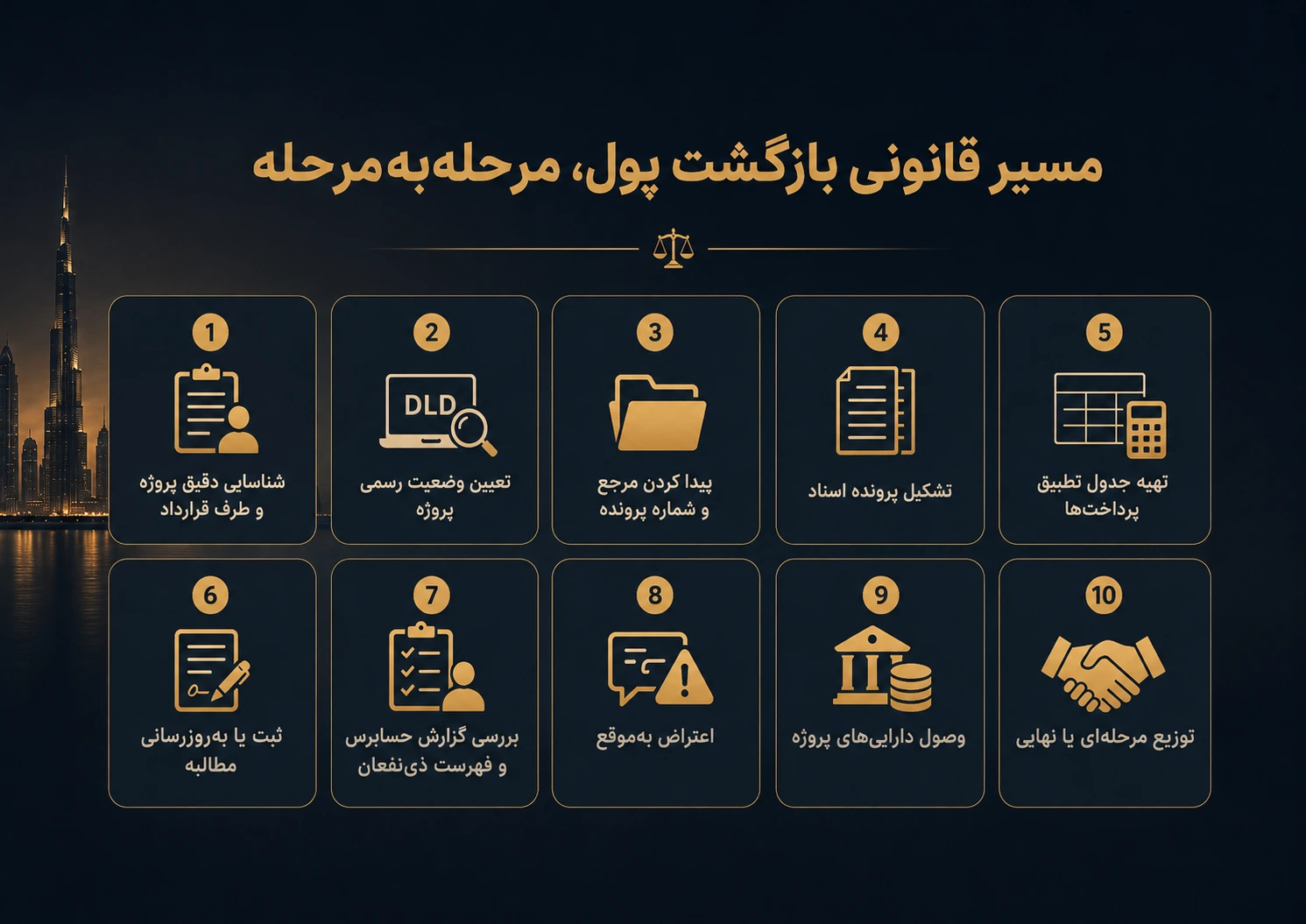
Legal path for refunding money, step by step
Step 1: Accurate identification of the project and contracting party
The advertising name of the project is not sufficient. Extract this information:
Legal name of the developer in the SPA;
Name of the master developer and sub-developer;
Project number and land;
Unit number and specifications;
Escrow account number and bank, if available;
Oqood number or initial registration;
Date and number of each transfer.
Step 2: Determine the official status
Check from DLD/Dubai REST whether the project is "stopped", "canceled", "canceled" or "in the process of revival". DLD has provided the possibility of immediate inquiry based on the name, project number, or land number.
Step 3: Find the authority and case number
It should be clarified whether the case is still in the administrative liquidation section of DLD or has been referred to the special authority for unfinished and canceled projects and has a case number or official notification.
Step 4: Form the document case
Organize all documents chronologically:
Reservation form and SPA;
Attachments and amendments;
Oqood certificate or initial registration document;
Official receipts from the manufacturer;
Bank transfers, SWIFT, checks, and account statements;
Invoice or statement issued by the manufacturer;
DLD registration fee receipt;
Correspondence regarding delays, cancellations, settlements, or transfers;
Assignment contract, NOC, and transfer chain documents;
Court ruling, enforcement order, arbitration ruling, or previous agreement;
Old and new passport, Emirates ID, and contact information;
Valid power of attorney, if a representative is acting;
IBAN and bank documents in the name of the beneficiary.
Step 5: Prepare the payment reconciliation table
Create a simple table:
Date | Amount | Recipient | Payment Method | Receipt/Reference Number | For What? | Document |
|---|---|---|---|---|---|---|
|
|
|
|
|
|
|
|
|
|
|
|
|
|
|
|
|
|
|
|
|
Separate the amounts paid to the project or manufacturer from the amounts paid to the previous seller, broker, bank, or government entity.
Step 6: Register or update the claim
Claims must be registered through the designated route for the respective project. The registration method, case number, and deadlines may vary for different projects. Do not rely on unofficial lists, WhatsApp messages from unknown individuals, or promises from intermediaries.
Step 7: Review of Auditor's Report and List of Stakeholders
Check the following items:
Full spelling of the name as per the passport;
Unit and project number;
Total accepted payment amount;
Deduction of previous refunds;
Correct transfer of rights from the previous owner;
Bank details;
Percentage or amount of distribution stage.
Step 8: Timely Objection
If you have been removed or the amount is incorrect, the objection must be documented, not just a letter of objection. Attach the bank receipt, transfer document, builder's confirmation, and previous ruling directly to the relevant dispute.
Step 9: Collection of Project Assets
Potential sources of payment include:
Balance of the escrow account;
Amounts that the trustee bank must release;
Sale of land or project rights;
Collectible claims from the builder;
Other assets that the authority allows to pursue;
Amount resulting from an agreement or entry of a substitute builder.
Step 10: Stage or Final Distribution
Before signing the receipt or agreement, clarify the payment:
Is provisional;
Is one stage of distribution;
Or is a complete and final settlement, waiving the remaining claims.
The text of a “Full and Final Settlement” can differ significantly from a stage payment.
What special points exist regarding contracts from 2006 and before 2008?
An old date does not alone extinguish the right
Article 11 amended in 2020 applies to off-plan contracts before and after the law. DLD has also stated that the escrow law includes projects announced before 2007 and a deadline was given for compliance.
However, there are four more serious evidentiary issues
Payment before escrow: Money may have gone directly into the company's account, making it difficult to trace.
Absence or defect of Oqood: It must be checked how the transaction or transfer was recorded in the initial register.
Premium of the secondary market: A significant part of the money may have been paid to the previous owner and may not exist in the builder's records.
Old documents and identity: Changes in passport, death of the buyer, inheritance transfer, change of name of the buying company, or loss of receipts can halt payment.
Statute of limitations should not be guessed
In a case nearly twenty years old, one cannot simply look at the contract date to say whether the claim has expired or not. Previous rulings, builder's admissions, claim registration, correspondence, entry of the case into liquidation, and the type of lawsuit can all affect the calculation of the deadline.
Additionally, the new Federal Civil Transactions Law will come into effect on June 1, 2026, and transitional issues must be examined alongside the law at the time of the contract. Anyone who has not yet registered any claims or whose name is not on the list should seek legal advice specific to their case immediately.
What amounts typically need to be examined separately?
The principal claim in the project is officially canceled, and the amounts paid by the buyer; however, in practice, it must be specified for each item to whom the money was paid and what document it has:
Down payment and unit price installments;
Reservation amount;
Amounts paid directly to the developer;
Amounts deposited into an escrow account;
Premium transfer in the secondary market;
Broker commission;
Registration fee or Oqood;
Administrative fees of the developer;
Contractual or legal profit;
Delay damages, lost opportunity, or financing costs;
Attorney, translation, and expert fees.
The law recognizes the buyer's principal payment refunds; however, profits, damages, and ancillary costs are not automatic and uniform in all cases. Acceptance of them depends on the text of the SPA, the recipient of the funds, documents, verdict, and decision of the special authority. Even if an amount is recognized as a claim in the verdict, the actual amount collected still depends on the enforceable assets.
Are there court fees for these cases?
Decree No. 33 of 2020 exempts requests, lawsuits, and objections within the jurisdiction of the special authority from the prescribed judicial fees. However, this exemption does not necessarily mean that all costs are free. Attorney fees, official translation, power of attorney, document certification, bank follow-up, or personal expert services may still apply.
What should be done if the project has not been officially canceled yet?
In this case, the rule for refunding a canceled project should not be applied automatically.
DLD explains in its official FAQ that DLD does not have the authority to terminate the contract between a buyer and the developer solely at the request of a buyer. If the project has not yet been canceled and the buyer wishes to terminate the contract, the matter may require agreement, contractual litigation, or proceedings in the competent authority.
However, after the 2020 decree, the special authority also has broad jurisdiction over referred unfinished projects and may approve the completion of the project by another developer instead of liquidation.
What happens if the project is revived?
The 2020 decree allows RERA to request the special authority to temporarily halt the liquidation process before its completion to explore the possibility of completing the project or resolving disputes. The authority may also assign the unfinished project to another developer.
In such a case, the possible solutions may include:
Completion of the same unit with revised conditions;
Transfer to another project or unit;
Financial agreement;
Entry of a new developer and continuation of contracts;
Or return to the liquidation process in case of failure of the revival plan.
The buyer should not accept the proposed transfer or settlement without reviewing the economic value and legal implications.

Common mistakes of buyers
The assumption that "construction has stopped" means the project has definitely been officially canceled;
Confusing the percentage of settlement with the penalty for the defaulting buyer in Article 11;
Relying on the project name in an old list and not checking the current status;
Providing only the SPA without bank documents and receipts;
Calculating the secondary market premium as money that is definitely in the escrow account;
Assuming that having an old ruling means immediate payment takes precedence over everything;
Not updating passport, email, phone, and IBAN;
Ignoring the notification or deadline for objections to the list of beneficiaries;
Signing the final settlement against a minor payment without understanding its legal effect;
Paying money to an intermediary who promises to "add the name to the DLD list" without official confirmation.
Immediate Checklist for Buyers of an Old Project
I have checked the official status of the project in DLD/Dubai REST.
I have the legal name of the developer, project number, land, and unit.
I know the project is either just stopped, in the process of cancellation, or officially canceled.
I have identified the Oqood number/initial registration or its absence.
I have gathered the SPA, appendices, and all transfer documents.
I have receipts or bank documents for each payment.
I have separated the money paid to the developer from the premium, commission, and government fees.
I have found the settlement file number or special reference.
I have checked my name and amount in the list of beneficiaries.
I have updated my passport, contact, and IBAN information.
If there is a dispute, I have filed an objection before the deadline.
I know the proposed payment is either a staged payment or a final settlement.
Frequently Asked Questions
Does the Dubai government guarantee to pay all money from the public budget?
The reviewed laws define the buyer's rights, escrow account, developer's liability, and settlement mechanism; however, they do not create a general and unconditional guarantee for the payment of deficits of all projects from the government budget.
If the escrow account is empty, does the buyer's right disappear?
Not necessarily. A lack of funds in the escrow account may leave a claim against the developer or other recoverable assets. However, the actual recovery amount depends on the asset, ruling, and settlement outcome.
Do all buyers of a project have to receive the same percentage?
DLD has stated the principle of full or proportional distribution based on the inventory. In the same class of confirmed claims, a proportional ratio is common; however, differences in accepted amounts, previous refunds, type of right, or specific authority decisions can lead to seemingly different outcomes.
If my name is not in Oqood, is the case closed?
No, but it is a serious issue. The reason for non-registration, SPA, payments, registration requests, transfers, and developer records must be investigated. The 2008 law made off-plan transaction registration mandatory, and regulations for late registration by the developer also have mechanisms. The outcome of any case depends on its documents.
Is a previous court ruling sufficient?
A final ruling is a very important document, but in a project subject to special settlement, its execution may occur within the project's collective mechanism. The text of the ruling and the enforcement status must be examined.
Can the ruling of the special authority be appealed?
Final decisions of the special authority are not subject to ordinary appeal. Therefore, objections to the auditor's report, removal of names, or incorrect amounts must be made within the stipulated timeframe and before the decision is finalized.
How long does settlement take?
There is no fixed and guaranteed time. DLD has explicitly stated that the duration of settlement can be indefinite, and each project is queued for processing based on the completion of documents, inventory, and identification of beneficiaries.
Where to obtain an official inquiry?
The current three general pathways are:
Project Status service on the DLD website;
Dubai REST application;
Official DLD call center at 8004488.
DLD also offers the online service Inquiries Concerning Contractual Disputes for receiving automated official responses regarding contractual disputes.
DLD Contractual Dispute Inquiry Service
Official DLD Contact Information
Summary
For buyers of old Dubai projects, the most important point is to not confuse a "project not built" with a "project officially canceled by RERA".
If there is a final cancellation by RERA, the legal principle is full refund of the amounts paid. However, settlement is a collective process: the auditor verifies the amount paid by each buyer, the escrow account balance and other assets are collected, settlement costs are deducted, and funds may be distributed fully or proportionally.
The decree of 2013 established a special authority for the settlement of canceled projects for the first time; however, since 2020, Decree No. 33 has been the main and broader framework for unfinished and canceled projects. The rulings of this authority are final and their execution is carried out through the Dubai Execution Court.
For someone who purchased between 2006 and 2008, there are four urgent actions:
Verify the official status of the project;
Find the file number and list of stakeholders;
Document all payments and the chain of transfer proof by proof;
Distinguish between "confirmed claim", "current distribution percentage" and "final settlement" based on the text of the ruling.
Sometimes the main issue is not proving the right; the problem is converting a definitive right into cash from the limited assets of the project.
